
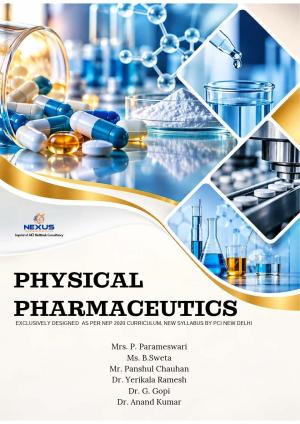
PHYSICAL PHARMACEUTICS
Keywords:
Solubility , Dissolution , Diffusion, Viscosity,Stability
Synopsis
Physical Pharmaceutics is an important branch of pharmaceutical science that deals with the application of physical and chemical principles to the development, formulation, preparation and evaluation of pharmaceutical dosage forms. It helps in understanding the physical and chemical properties of drugs and their effects on the stability, solubility, absorption and bioavailability of pharmaceutical products.
Physical Pharmaceutics involves the study of various concepts such as solubility, dissolution, diffusion, surface tension, viscosity, rheology, pH, buffers, drug stability and chemical kinetics. These principles are essential for preparing safe, effective and stable pharmaceutical formulations.
It also deals with different dosage forms, including tablets, capsules, suspensions, emulsions, ointments, creams and other pharmaceutical preparations. The subject explains how different ingredients interact with one another and how these interactions influence the quality and performance of medicines.
Physical Pharmaceutics plays an important role in drug formulation and development by helping pharmaceutical scientists select suitable ingredients, improve drug solubility, maintain stability and enhance drug delivery. It also provides knowledge about the physical properties of pharmaceutical substances and the techniques used for their evaluation and quality control.
The study of Physical Pharmaceutics is essential for pharmacy students because it provides a scientific foundation for the preparation, development, testing and storage of pharmaceutical products. It contributes to the development of safe, effective, stable and high-quality medicines.
Published
November 19, 2026
Copyright (c) 2026 Nexus Knowledge Publication (Imprint of AKT Multitask Consultancy)
License

This work is licensed under a Creative Commons Attribution-NonCommercial-NoDerivatives 4.0 International License.
How to Cite
Mrs. P. Parameswari, Ms. B.Sweta, Chauhan, M. P. C., Ramesh, D. Y. R., Dr. G. Gopi, & Dr. Anand kumar. (2026). PHYSICAL PHARMACEUTICS. Nexus Knowledge Publication (Imprint of AKT Multitask Consultancy). https://doi.org/10.64474/